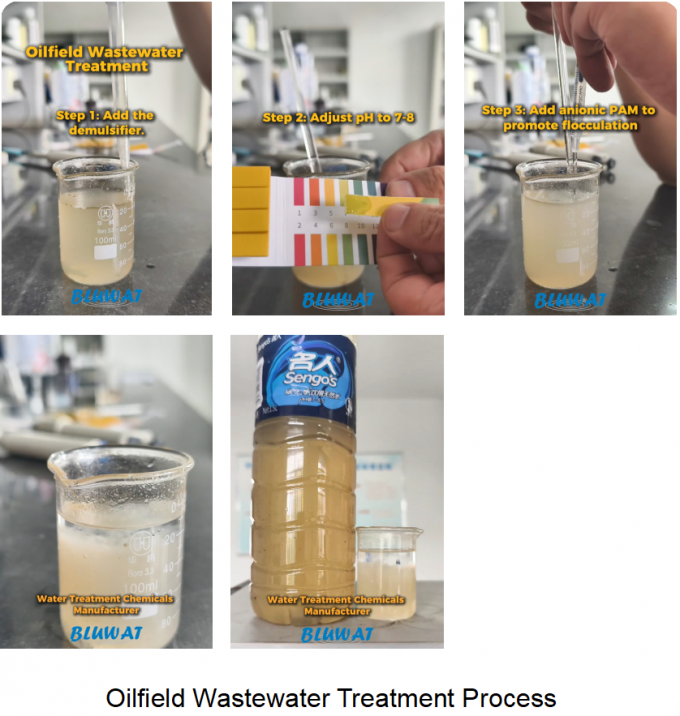
Test conclusion: In this laboratory test, an oilfield wastewater sample was treated with a demulsifier, adjusted to pH 7–8, and then dosed with anionic polyacrylamide (PAM). The treated sample appeared lighter and less visibly turbid than the untreated wastewater. This is a visual observation; oil removal efficiency and discharge compliance require laboratory measurements.
Oilfield wastewater may contain emulsified oil and suspended particles that are difficult to separate by settling alone. Bluwat Chemicals carried out a jar test to observe how this wastewater sample responded to a three-step chemical treatment process.
A demulsifier was added to help destabilize the oil-water emulsion and support the separation of dispersed oil from the water phase.
The wastewater pH was adjusted to 7–8 before the flocculant was added.
Anionic polyacrylamide (PAM) was added to promote flocculation, helping destabilized droplets and suspended particles form larger aggregates for separation.
Experiment steps: demulsifier addition → pH adjustment to 7–8 → anionic PAM flocculation.
In the comparison photograph, the untreated wastewater on the left appears darker and more turbid. The treated sample on the right appears lighter after the three-step jar test, although some cloudiness remains.
Left: untreated oilfield wastewater. Right: treated sample after demulsification, pH adjustment, and flocculation.
The photograph records the visible result of this jar test. It does not establish a numerical oil removal rate, COD reduction, or whether the treated water meets a discharge standard. Those results must be confirmed through testing.
Each step has a different role. The demulsifier helps break the oil-water emulsion. The pH is then adjusted to 7–8 before anionic PAM is added. Finally, PAM promotes the formation of larger flocs that can be separated from the water. Chemical grades and dosages should be selected according to the actual wastewater sample and treatment target.
The order was demulsifier first, pH adjustment to 7–8 second, and anionic PAM third.
In this test, the wastewater was brought to the selected pH range of 7–8 before the flocculation step. The suitable pH range should be confirmed for each wastewater sample through jar testing.
No. It shows a visible difference between the untreated and treated samples. Calculating oil removal requires measured oil concentrations before and after treatment.
Bluwat Chemicals can help assess demulsification and flocculation options using your wastewater sample. Share your water characteristics and treatment target to support chemical selection and jar testing.
Test conclusion: In this laboratory test, an oilfield wastewater sample was treated with a demulsifier, adjusted to pH 7–8, and then dosed with anionic polyacrylamide (PAM). The treated sample appeared lighter and less visibly turbid than the untreated wastewater. This is a visual observation; oil removal efficiency and discharge compliance require laboratory measurements.
Oilfield wastewater may contain emulsified oil and suspended particles that are difficult to separate by settling alone. Bluwat Chemicals carried out a jar test to observe how this wastewater sample responded to a three-step chemical treatment process.
A demulsifier was added to help destabilize the oil-water emulsion and support the separation of dispersed oil from the water phase.
The wastewater pH was adjusted to 7–8 before the flocculant was added.
Anionic polyacrylamide (PAM) was added to promote flocculation, helping destabilized droplets and suspended particles form larger aggregates for separation.
Experiment steps: demulsifier addition → pH adjustment to 7–8 → anionic PAM flocculation.
In the comparison photograph, the untreated wastewater on the left appears darker and more turbid. The treated sample on the right appears lighter after the three-step jar test, although some cloudiness remains.
Left: untreated oilfield wastewater. Right: treated sample after demulsification, pH adjustment, and flocculation.
The photograph records the visible result of this jar test. It does not establish a numerical oil removal rate, COD reduction, or whether the treated water meets a discharge standard. Those results must be confirmed through testing.
Each step has a different role. The demulsifier helps break the oil-water emulsion. The pH is then adjusted to 7–8 before anionic PAM is added. Finally, PAM promotes the formation of larger flocs that can be separated from the water. Chemical grades and dosages should be selected according to the actual wastewater sample and treatment target.
The order was demulsifier first, pH adjustment to 7–8 second, and anionic PAM third.
In this test, the wastewater was brought to the selected pH range of 7–8 before the flocculation step. The suitable pH range should be confirmed for each wastewater sample through jar testing.
No. It shows a visible difference between the untreated and treated samples. Calculating oil removal requires measured oil concentrations before and after treatment.
Bluwat Chemicals can help assess demulsification and flocculation options using your wastewater sample. Share your water characteristics and treatment target to support chemical selection and jar testing.